About the Project
MORE4WATER is a European project funded under the Water4All Partnership, an international collaborative effort aimed at enhancing the management of water resources in the face of increasing hydroclimatic challenges.
These efforts are directed toward improving water distribution and irrigation systems, promoting sustainable use and efficient management, in line with the UN Agenda 2030 and the EU Green Deal.
The Challenge
The project stems from four key concerns
WATER
USE
Most freshwater is stored in groundwater, with only a small portion in lakes. About 70% is used for irrigation, putting pressure on resources.
WATER
SCARCITY
Around 50% of the global population faces water shortages each year, driven by overuse and increasingly frequent climate-related droughts.
DROUGHT IMPACTS
Prologed droughts reduce water supply, create social tensions, and force complex decisions across technical, legal, and socio-economics levels.
TRANSBOUNDARY COMPLEXITY
Managing shared water resources is increasingly challenging due to diverse physical, political, and socio-economic conditions.
Our Solution
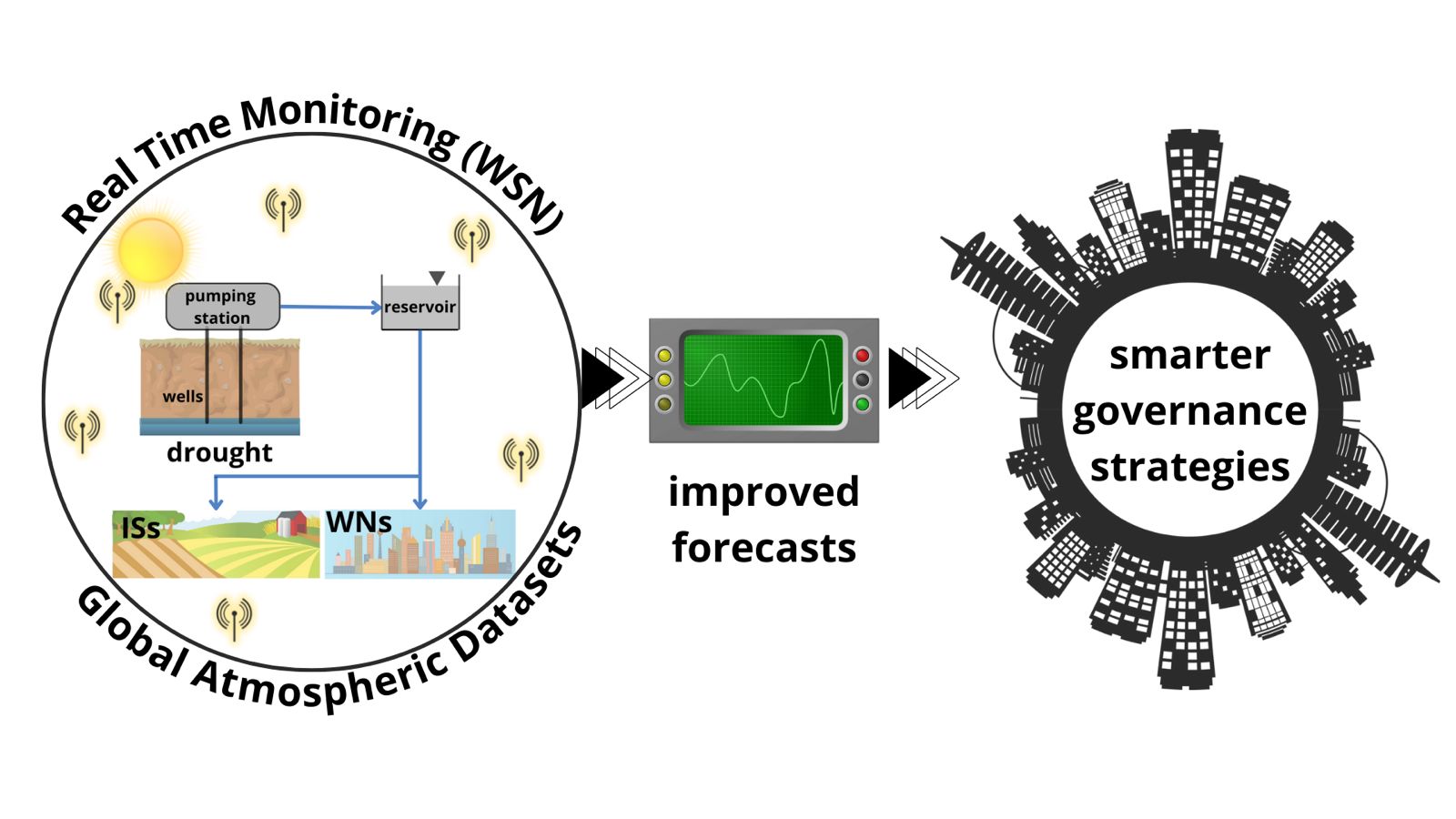
The MORE4WATER project aims to develop an innovative technology that uses efficient real-time monitoring to improve water availability forecasts and enhance the management of water distribution and irrigation systems.
This technology will significantly reduce the impact of droughts and support the next generation of systems to be more monitored, controlled, efficient, sustainable, and “smart”.
The Strategy
To address these challenges, the project follows a four-pronged strategy:
1
ACTION
Development of “user-friendly” models (AQUILA) for simulating and forecasting groundwater and lake levels, using global atmospheric datasets provided by global circulation models and ground-based smart sensors acquired by an ad-hoc wireless sensor network. This network will also monitor water distribution and irrigation systems.
2
ACTION
Definition of innovative management criteria for water distribution and irrigation systems in line with digital transition goals. These include leakage reduction, pressure control, and energy efficiency. Emphasis is placed on leakage reduction as the mostsustainable and cost-effective way to preserve existing freshwater resources.
3
ACTION
Application of the model to support drought monitoring and adaptation, strengthening the implementation of existing legal frameworks for managing and sharing transboundary water resources.
4
ACTION
Active dissemination, cross-sector collaboration, and exploitation of results for maximizing socio-economic impact.